


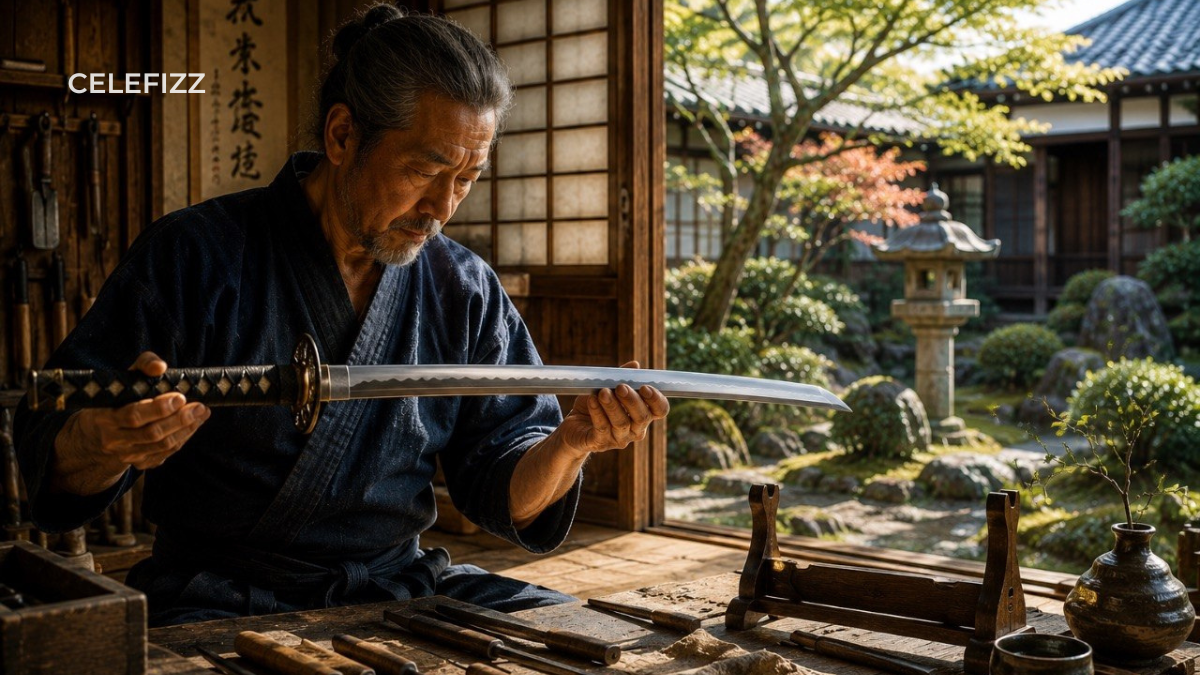
Can a sword cost more than a Porsche 911 GT3, a Lamborghini Huracán, or a Ferrari Roma? Can its price be high enough to buy a luxury sea-facing apartment in Dubai? Surprisingly, the answer is yes.
A luxury Japanese Katana sword can be worth millions of dollars. Some of the finest examples are more expensive than many famous supercars. This may sound unbelievable because swords no longer play a role in modern warfare. Today, battles are fought with firearms, missiles, and advanced military technology. So, why does a sword still command such an extraordinary price?
The answer lies in the qualities that define true luxury. The value of a luxury item is not determined by the materials alone. It also depends on its history, cultural heritage, rarity, craftsmanship, the time required to create it, and the exceptional skill and patience of the artisans. Every masterpiece tells a story that cannot be mass-produced.
The Japanese Katana belongs to this rare category of luxury. It is admired not only as a weapon but also as a work of art, a cultural treasure, and a symbol of centuries-old craftsmanship.
A supercar begins to lose its value the moment it leaves the showroom. After a few decades, it may become outdated or even worthless. A handcrafted Katana, however, can preserve its beauty, historical importance, and financial value for hundreds of years. In many cases, its worth continues to increase with time.
For this reason, owning a handcrafted Japanese Katana is more than making a purchase. It is an investment in history, cultural legacy, and timeless craftsmanship.
Let us explore what makes the Japanese Katana one of the world’s most valuable luxury items.
The Steel That Outlives Time
Not Just a Weapon
Just as a work of art by Leonardo da Vinci is more than a collection of colors, a Japanese Katana is more than a piece of steel. Every great painting reflects the artist’s vision and philosophy. In the same way, every authentic Japanese Katana carries the spirit of Samurai culture and the wisdom of Zen philosophy.
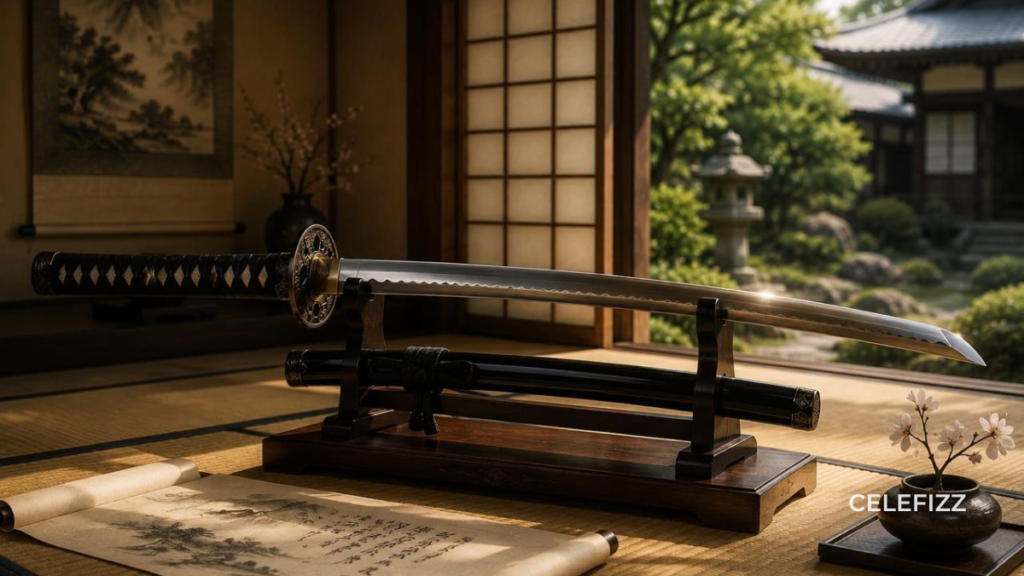
A genuine Japanese Nihonto is never regarded as an ordinary weapon. It is admired as a “Sculpture in Steel.” Its beauty lies not only in its flawless craftsmanship but also in the values, traditions, and history forged into every blade.
Philosophy & Art
The Katana beautifully reflects Japan’s Wabi-Sabi philosophy. This timeless philosophy teaches people to find beauty in simplicity, peace in imperfection, and meaning in the temporary nature of life.
One of the most fascinating features of a Katana is the Hamon, the graceful wave-like pattern that runs along the edge of the blade. It is not painted, engraved, or polished onto the steel. Instead, it appears naturally during the traditional heat treatment and quenching process. The Hamon is the result of fire, water, and the swordsmith’s skill working together.
Even more remarkable is the fact that no two authentic Katanas have exactly the same Hamon. Each pattern is unique, making every sword a one-of-a-kind work of art.
The Wabi-Sabi philosophy celebrates natural imperfection instead of perfect uniformity. A Katana is a living example of this idea. The subtle marks left by the craftsman’s hands, the naturally formed Hamon, and the gentle patina that develops over time give each sword its own personality and soul.
The Soul of the Samurai
An old Japanese saying declares, “The sword is the soul of the Samurai. If he loses it, he loses himself.”
The Katana preserves the legacy of the entire Samurai tradition. It is respected not only as a sword but also as the symbol of Bushido, the Samurai Code of Honor. Bushido formed the moral foundation of Samurai life and shaped their character for centuries.
Its seven core principles are:
1. Gi (Righteousness): Always choose what is right and just.
2. Yu (Courage): Do the right thing without fear.
3. Jin (Compassion): Protect the weak and show kindness.
4. Rei (Respect): Treat everyone with courtesy, even your enemies.
5. Makoto (Honesty): Keep your word without compromise.
6. Meiyo (Honor): Live and, if necessary, die with honor.
7. Chugi (Loyalty): Remain loyal to your lord until your final breath.
For this reason, the Katana is revered as the very soul of the Samurai.
When a collector spends $200,000 on an authentic Japanese Katana today, they are not simply buying a steel blade. They are preserving a piece of Japan’s thousand-year-old history, Samurai tradition, and centuries-old legacy.
History & Cultural Journey: The Soul of the Samurai and the Katana
The Japanese Katana is far more than a weapon. For nearly a thousand years, it has symbolized the honor, identity, and spirit of the Samurai.
As an old Japanese saying goes, “The sword is the soul of the Samurai.” Its remarkable journey through history is one of the main reasons why the Katana is admired today as both a cultural treasure and a luxury collectible.
1. The Rise of the Samurai (12th–14th Century)
During the 12th century, Japan’s central government weakened, and powerful military leaders known as Shoguns rose to power. At the same time, the Samurai emerged as an elite warrior class governed by the Bushido Code of Honor.
To meet the demands of mounted combat, Japanese swordsmiths gradually developed the curved Katana. Its sharp edge, perfect balance, and quick draw made it an ideal battlefield weapon. More importantly, it became the Samurai’s most treasured possession and a symbol of honor and loyalty.
2. The Age of Warring States (15th–16th Century)
For more than a century, Japan was divided among rival Daimyo, who fought constantly for power and territory. This era, known as the Sengoku Jidai, was one of the bloodiest periods in Japanese history.
As warfare intensified, the demand for highly skilled Samurai and master swordsmiths reached its peak. The Katana became a symbol of survival, courage, and personal honor, earning a legendary reputation throughout Japan.
3. The Golden Age of the Katana (1603–1868)
After Tokugawa Ieyasu unified Japan in 1603, the country entered the peaceful Edo Period, which lasted for more than 250 years. With fewer wars to fight, the Katana gradually transformed from a battlefield weapon into a symbol of social status, artistic excellence, and cultural pride.
Only Samurai were allowed to wear a Katana in public. During this peaceful era, master swordsmiths refined every detail of the blade, elevating the Katana into a true work of art admired for both its beauty and craftsmanship.
4. The Meiji Restoration: The End of the Samurai Era (1853–1876)
In 1853, an American naval fleet under the command of Commodore Matthew Perry arrived in Japan. The Tokugawa Shogunate was forced to sign unequal treaties and open the country to trade with the United States and other Western powers. These humiliating agreements sparked widespread political unrest and weakened the authority of the Shogun.
The unrest eventually led to the Meiji Restoration in 1868, ending more than 250 years of Shogun rule. As Japan rapidly modernized, the Samurai class was abolished. In 1876, the Haitorei Edict banned the public wearing of swords. Although the Katana disappeared from everyday life, it remained a lasting symbol of Japan’s history, culture, and Samurai spirit.
5. Modern Japan: A Living Legacy
In 1945, World War II ended. Japan lost the war.
The country lay in ruins. Its cities were destroyed. Its old military government collapsed.
What followed changed Japan forever.
American-led forces occupied the country until 1952.
A new constitution was written in 1947. Japan became a democracy.
Slowly, from the ashes, a new nation rose. It built factories instead of armies. It chose technology over war. Within decades, Japan became one of the richest economies in the world.
This is the Japan we know today. And this is where the Katana’s modern story truly begins.
A Tradition That Almost Died Twice:
The Katana’s journey has two dark chapters.
The first came in 1876. The Haitorei Edict banned the public wearing of swords. The Samurai era ended.
The second came after World War II. The Allied Occupation banned sword production completely. Workshops shut down. Master swordsmiths grew old.
No new apprentices came to learn the craft.
For a while, it seemed the Katana might vanish forever. But it survived.
Japan later allowed sword-making again, under strict rules. Slowly, the tradition came back to life.
It had faced extinction twice, and both times, it endured.”
The Katana also remains deeply connected to martial arts, such as Kendo and Iaido. Once a weapon of war, it is now celebrated worldwide as a masterwork of craftsmanship, cultural heritage, and timeless luxury.
Why Is a Handcrafted Katana the Ultimate Luxury?
An object earns the status of luxury only when it possesses exceptional qualities that set it apart from ordinary versions of the same kind.
True luxury is defined by heritage, culture, craftsmanship, patience, rarity, and exceptional value. A handcrafted Japanese Katana embodies all of these qualities. More than a beautifully crafted blade, it is a masterwork shaped by centuries of tradition and human skill.
1. Exceptional Heritage & Cultural Value
The Katana holds a revered place in Japanese culture. For centuries, it has symbolized the honor, discipline, and loyalty of the Samurai. As an old Japanese saying goes, “The sword is the soul of the Samurai.” It is the strongest physical symbol of Bushido, the Samurai Code of Honor. This profound cultural and historical significance gives the Katana a value that extends far beyond its physical form.
2. Time, Patience & Dedication
In today’s world of instant production, time itself has become a luxury. Completing an authentic Japanese Katana typically takes six months to a year, and sometimes even longer. Every stage is carried out by hand with extraordinary patience and precision. Rather than being manufactured in a factory, each Katana is the result of months of dedication by highly skilled artisans.
3. Master Craftsmanship
A premium Katana is never the work of a single craftsman. It is a collaborative work created by several specialists, each contributing years of experience to a specific stage of the process. The master swordsmith shapes and heat-treats the blade, the polisher reveals its beauty and Hamon, the scabbard maker crafts the lacquered Saya, the Tsuba artisan creates the handguard, and the handle maker completes the traditional grip. Together, they transform steel into a timeless work of art.
4. Extreme Rarity & Strict Regulations
The rarity of an authentic Nihonto is protected by its time-consuming craftsmanship as well as by Japan’s strict regulations.
Today, only a small number of licensed swordsmiths remain. Around 300 people hold a license to forge swords in Japan. But only about 30 of them work at it full-time.
A licensed master swordsmith is legally allowed to craft no more than two long swords a month.
This does not mean a complete Katana is finished within a few weeks. Once the master swordsmith completes the blade, it is passed to other specialist craftsmen for polishing, mounting, scabbard making, and final assembly. While they continue their work, the swordsmith begins crafting the next blade. As a result, several Katanas are completed simultaneously at different stages of production without compromising traditional quality.
5. The Astonishing Price Tag
A handcrafted Japanese Katana is among the world’s most valuable luxury collectibles. A newly crafted sword by a renowned master swordsmith may cost between $30,000 and more than $200,000. Exceptional historical Katanas with outstanding provenance have sold for several million dollars at international auctions.
Three main factors determine a Katana’s value. The first is its age and historical period, such as the Kamakura or Edo era. The second is its provenance—whether it was owned by a famous Samurai, a powerful Daimyo, or a Shogun. The third is the reputation of the master swordsmith who created it.
Many authentic Katanas also bear the swordsmith’s signature, known as Mei, engraved on the tang (Nakago). For collectors, it is an important mark of authenticity and authorship. A famous signature can greatly increase a sword’s historical importance and market value.
For serious collectors, an authentic Katana is far more than an expensive object. It is a rare investment in history, art, and cultural heritage.
Evolution & Anatomy: Features of a Legendary Blade
A Katana is far more than a piece of metal; it is a cultural icon of ancient metallurgy and human craftsmanship. Its iconic curve, incredible strength, and razor-sharp precision make it one of the most deadly yet breathtaking weapons ever created. Here is a breakdown of the technical brilliance behind a legendary Katana:
1. Tamahagane Steel (The Sacred Japanese Steel)
The soul of a Katana lies in its metal—Tamahagane (literally translated as “Jewel Steel”). To create this rare alloy, Japanese swordsmiths smelt black iron sand (Satetsu) and charcoal in a traditional clay furnace called a Tatara. The furnace burns continuously for 3 days and 3 nights at temperatures exceeding 1,400°C, yielding high-purity, carbon-rich steel.
💡 DID YOU KNOW?
Why is Tamahagane Called “Jewel Steel”?
In Japanese, Tamahagane (玉鋼) literally translates to “Jewel Steel” (Tama = Jewel/Precious, Hagane = Steel).
This doesn’t mean it contains actual gemstones. Instead, after burning continuously for 3 days and 3 nights inside the traditional clay furnace (Tatara), the master smiths break open the furnace to extract the highest-purity, carbon-rich steel. The raw, glowing fragments resemble precious raw jewels.
Due to its extreme purity, rarity, and jewel-like radiance, Japanese swordsmiths have revered this sacred metal as “Jewel Steel” for over a millennium.
2. The Folding Technique (Purification Through 10–15 Folds)
The master swordsmith repeatedly heats, hammers, and folds the Tamahagane steel 10 to 15 times.
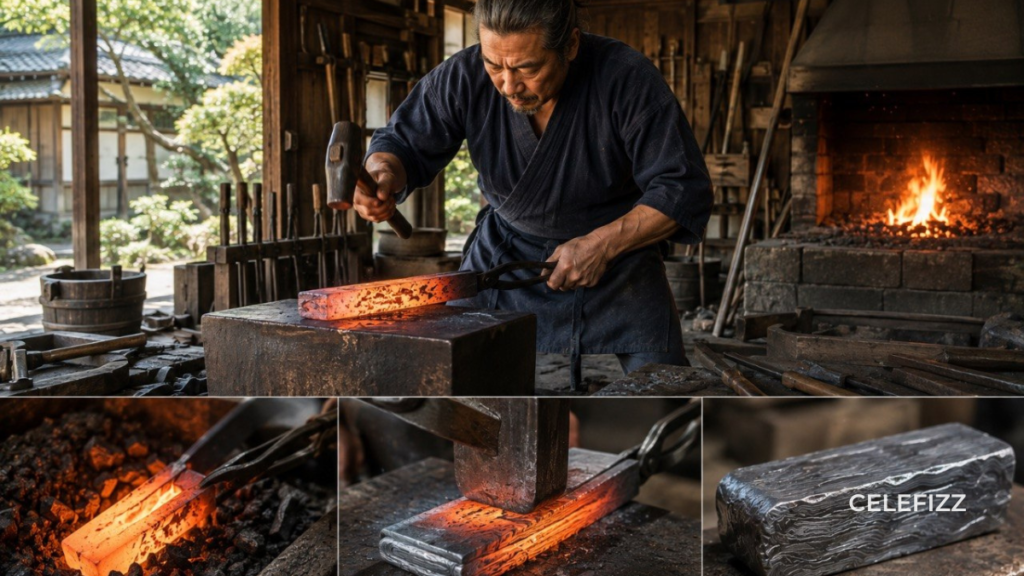
After repeated folding, the blade may contain tens of thousands of microscopic layers, depending on the forging process.
This painstaking process removes impurities and spreads carbon evenly throughout the steel. As a result, the blade becomes stronger, more flexible, and far more resistant to breaking.
3. Clay Tempering & Differential Hardening (The Magic of Clay)
To make the Katana both razor-sharp and resilient, swordsmiths use a unique technique called Differential Hardening. Before quenching, the blade is coated with clay—a thin layer along the cutting edge and a thick layer along the spine. When quenched in water, the thin-clay edge cools rapidly, making it glass-hard and sharp, while the thick-clay spine cools slowly, remaining shock-absorbent and flexible.
4. The Hamon Wave Line (The Blade’s Natural Fingerprint)
During the clay-tempering process, a striking, wave-like pattern naturally emerges along the cutting edge, known as the Hamon. This is a prime reflection of the Wabi-Sabi philosophy—no two Katanas in the world share the same Hamon. It serves as the blade’s unique, unforgeable fingerprint.
🗡️ Anatomy of a Katana
A complete Katana is a harmonious assembly of four main handcrafted components:
Tsuba (Guard): The ornate, circular or square handguard decorated with intricate engravings, often inlaid with gold, silver, or brass.
Tsuka (Handle): The hilt, crafted from wood, wrapped in authentic ray skin (Samegawa), and bound in traditional silk cord (Ito) for a firm, non-slip grip.
Saya (Scabbard): The protective wooden sheath finished with multiple coats of traditional Japanese lacquer.
Habaki (Collar): The small brass or gold collar fitted at the base of the blade, which locks the Katana securely into its scabbard and absorbs shock.
The Legendary Mastersmiths: Creators of Divine Blades
In the history of the Katana, two names stand so tall that their legacies border on the divine and the mythical. Although they lived centuries apart, Japanese folklore often compares them to contrast two entirely different philosophies of swordmaking:
1. Goro Nyudo Masamune (The Prophet of Peace & Justice)
Era: Late 13th to early 14th Century (Kamakura Period)
Legacy: Masamune is widely considered the greatest master swordsmith in Japanese history. He founded the Soshu School, one of Japan’s most influential sword-making traditions. He also perfected the ‘Nie’ crystal effect, which gave the blade a bright, sparkling appearance.
Philosophy: Masamune’s swords were revered not merely as weapons, but as spiritual talismans of protection. Legend holds that a Masamune blade possesses a noble spirit: it unsheathes only to defend justice, honor, and the innocent.
2. Sengo Muramasa (The Master of the Cursed Blade)
Era: 16th Century (Sengoku Period)
Legacy: Muramasa was a genius known for forging blades with unmatched, razor-sharp lethality. During an era of intense civil war, warriors actively sought his weapons for their terrifying performance in battle.
Philosophy & The Curse: According to Japanese folklore, Muramasa’s blades were believed to be bloodthirsty and cursed. Because several members of the Tokugawa family were killed or injured by Muramasa swords, these blades became associated with misfortune. They gradually fell out of favor during the Tokugawa era.
Some even claim that the Tokugawa Shogunate completely banned Muramasa swords. However, there is no conclusive historical evidence to support this claim.
🌊The River Test: A Tale of Two Philosophies
A famous Japanese legend beautifully illustrates the contrast between these two masters:
Both smiths placed their finished swords vertically into a flowing river. Muramasa’s blade cut everything that touched it – floating leaves, passing fish, and even the air itself were sliced cleanly in two.
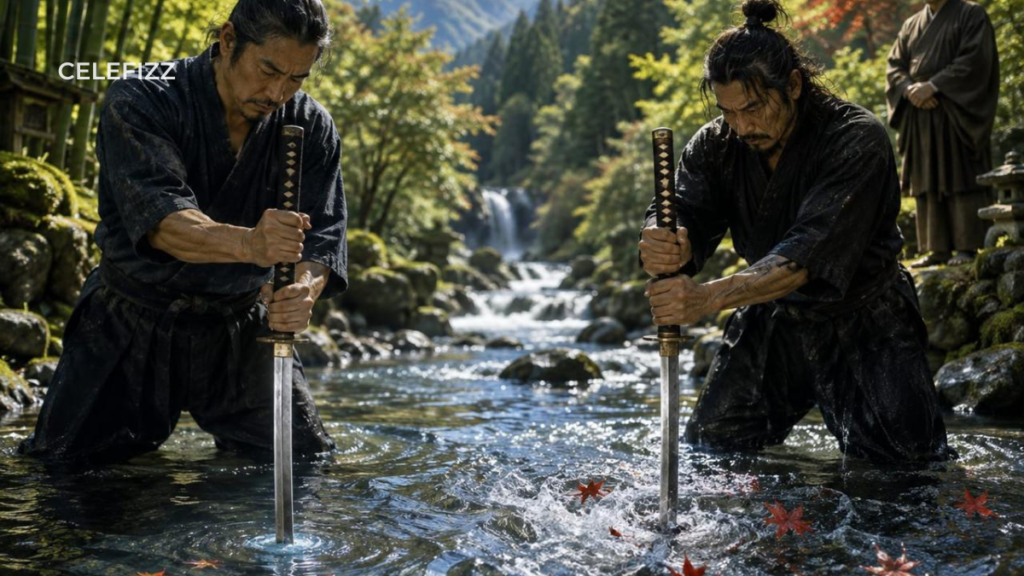
When Masamune’s sword was placed in the water, the leaves and fish swam gently around the blade, untouched. The water seemed to part peacefully around it.
A watching Zen monk observed the test and declared:
“Muramasa’s sword is a bloodthirsty weapon of destruction – it cuts without distinction. But Masamune’s sword is a sacred guardian of peace – it refuses to harm the innocent.”
3. Modern Living National Treasures (The Masters of Today)
This ancient craft has survived for more than a thousand years. Today, a small number of highly skilled Japanese swordsmiths continue to preserve this remarkable tradition. Some have been honored by the Japanese government as Living National Treasures for their outstanding contribution to traditional craftsmanship. Using centuries-old techniques, these masters continue to create authentic Nihonto with the same patience, precision, and dedication that defined their predecessors.
Why Collectors Invest Millions in a Katana
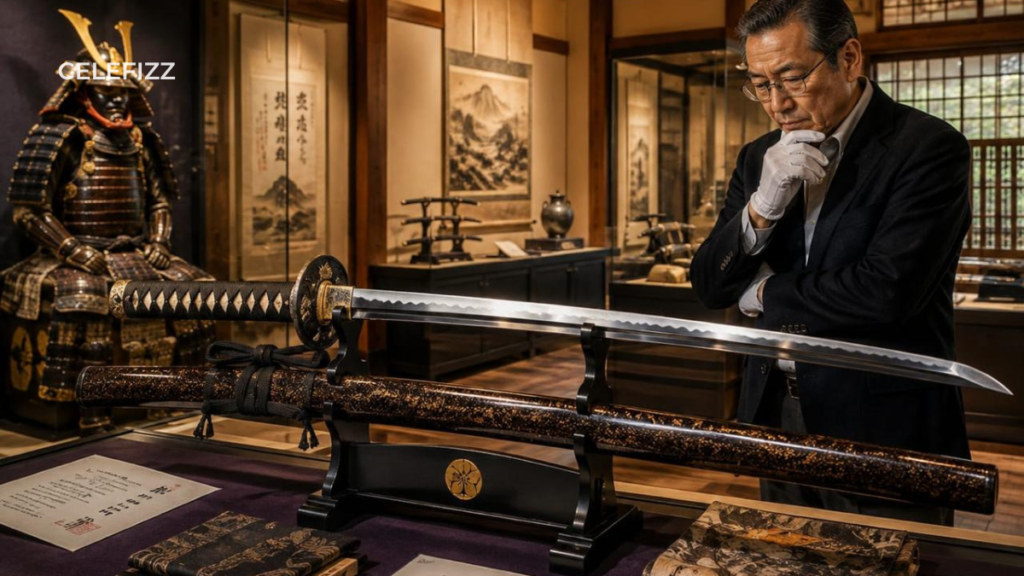
To the untrained eye, a Katana might look like an exquisite piece of steel. But to high-net-worth collectors, auction houses, and investors, an authentic Japanese blade (Nihonto) is a tangible asset class—a “guilt-free luxury” that merges ancient heritage with extraordinary financial performance.
Here is why elite buyers are willing to pay millions of dollars for a single blade:
1. Heritage, Prestige & Social Reputation
A Living Legacy: Owning a Katana is not just possessing a weapon; it is holding a 1,000-year-old piece of Samurai history and the Bushido code.
Ultimate Status Symbol: Displaying an authentic Japanese blade in a private gallery signifies peak refinement, sophisticated taste, and immense financial privilege.
2. A Valuable Tangible Asset
Unlike most consumer goods, an authentic Katana can retain its value for generations. Exceptional historical blades have often been appreciated over time because of their rarity, craftsmanship, and cultural significance. For many collectors, a Katana is not only a work of art but also a valuable tangible asset.
3. Global Tradability:
Authentic Japanese Katanas are often accompanied by official certification papers issued by the NBTHK (Nihon Bijutsu Token Hozon Kyokai), Japan’s leading organization for the preservation and authentication of traditional Japanese swords.
💰 The Million-Dollar Valuation: Rarity, Craft & History
The price of a Japanese Katana can range from $20,000 to several million dollars. But what exactly determines its value? The answer lies in three key factors:
Strict Legal Rarity:
By Japanese law, a certified master swordsmith is legally restricted to crafting only two Katanas per month (maximum 24 per year). This artificially capped supply creates fierce global demand.
Unmatched Master Craftsmanship:
It takes up to five master artisans working for 6 to 12 months—folding Tamahagane steel into over 30,000 microscopic layers—to create a single blade. No modern machinery or AI can replicate this human skill.
Museum-Grade Provenance:
The most expensive blades date back to the Kamakura or Edo periods and carry legendary lineage (provenance)—often forged by historic grandmasters like Masamune or wielded by famous Shoguns.
The Verdict:
Investing in a Katana is like acquiring a Monet painting or a rare piece of gold—it is a timeless treasure you can display today, which quietly appreciates to become an irreplaceable family heirloom tomorrow.
Conclusion: A Timeless Masterpiece
A Katana is much more than an expensive collectible or a historical sword. It is a symbol of patience, hard work, and Japanese culture.
Even after 1,000 years, the beauty and legend of the Katana remain unchanged. Whether you look at it as a piece of art, a smart investment, or a story of legendary masters, the Katana will always hold a special place in human history.
